Unmanned Aerial Vehicles (UAVs), commonly known as drones, have evolved from simple remote-controlled tools to sophisticated technological systems that reshape industries, redefine convenience, and push the boundaries of what is possible in the sky. Over the past century, their development has been driven by technological innovation, changing market demands, and evolving regulatory frameworks, transforming them from military assets to indispensable tools in civilian life, business operations, and scientific research.
The origins of drones can be traced back to the mid-19th century, with the first recorded use of unmanned aerial devices dating to 1849, when Austria used balloon bombs in Venice during a military conflict. However, it was not until the 20th century that drones began to take shape as we know them today. During World War I, Britain developed radio-controlled aircraft, while the United States created the Kettering Bug, an unmanned torpedo, laying the groundwork for modern drone technology. The term “drone” was popularized in the 1930s with Britain’s DH.82B Queen Bee drone, used primarily for training purposes. By World War II, drones were mass-produced for training and reconnaissance, marking the start of their large-scale military application.
The post-World War II era saw significant advancements in drone technology, fueled by military funding and the Cold War’s demand for surveillance. The United States’ CIA and Pentagon invested heavily in drone reconnaissance, developing models like the Ryan Firebee for spy missions. In the 1970s and 1980s, Abraham Karem, known as the “father of the Predator drone,” pioneered long-endurance UAVs, which revolutionized military surveillance and combat capabilities. By the 2000s, armed drones like the Predator and Reaper became central to counter-terrorism operations, reducing risk to human life while enabling precision targeting in conflict zones worldwide.
In recent decades, the focus of drone development has shifted from military to civilian and commercial applications, driven by breakthroughs in core technologies. One of the most significant advancements is in power systems: hydrogen fuel cells, such as South Korea’s Doosan DP30 system with an energy density of 800Wh/kg (three times that of lithium batteries), have extended drone flight time to over 5 hours, while hybrid systems from companies like Skyfront enable 8-hour endurance for long-haul tasks like oil pipeline inspection. Wireless charging technology, developed by teams like Ouyang Minggao’s, allows drones to automatically recharge during operations, supporting 24-hour uninterrupted work in scenarios like agricultural spraying.
Artificial intelligence (AI) has also transformed drone capabilities, enabling end-to-end autonomous decision-making. Google DeepMind’s AlphaDrone system, powered by deep reinforcement learning, boasts a 99.998% accuracy rate in navigating complex urban environments—outperforming human operators. Predictive maintenance technologies, such as Siemens’ digital twin system, have cut unexpected drone downtime by 75% and reduced maintenance costs by 60%. Additionally, adaptive flight control systems, like DJI’s latest technology, adjust parameters in real time to handle extreme weather, boosting control precision fivefold compared to traditional systems.
Communication technology has further expanded drone use cases, with 5G-A and 6G networks delivering high-bandwidth, low-latency connectivity. China Mobile’s 5G-A drone private network supports 100 drones transmitting 4K video simultaneously with a latency of less than 5 milliseconds. Low-orbit satellite communication, such as Starlink’s drone terminals, provides global coverage, allowing drones to operate in remote areas without ground network access—including polar scientific expeditions. Huawei’s cognitive radio technology lets drones dynamically select optimal communication frequencies, increasing reliability to 99.999% in dense urban areas.
Today, drones have permeated hundreds of industries, unlocking new possibilities across sectors. A key reason for their widespread adoption is their clear advantages over traditional methods, which have long been held back by inefficiency, high risk, and limited reach in many scenarios. This comparison explains why drones are quickly replacing or supplementing traditional approaches in various fields.
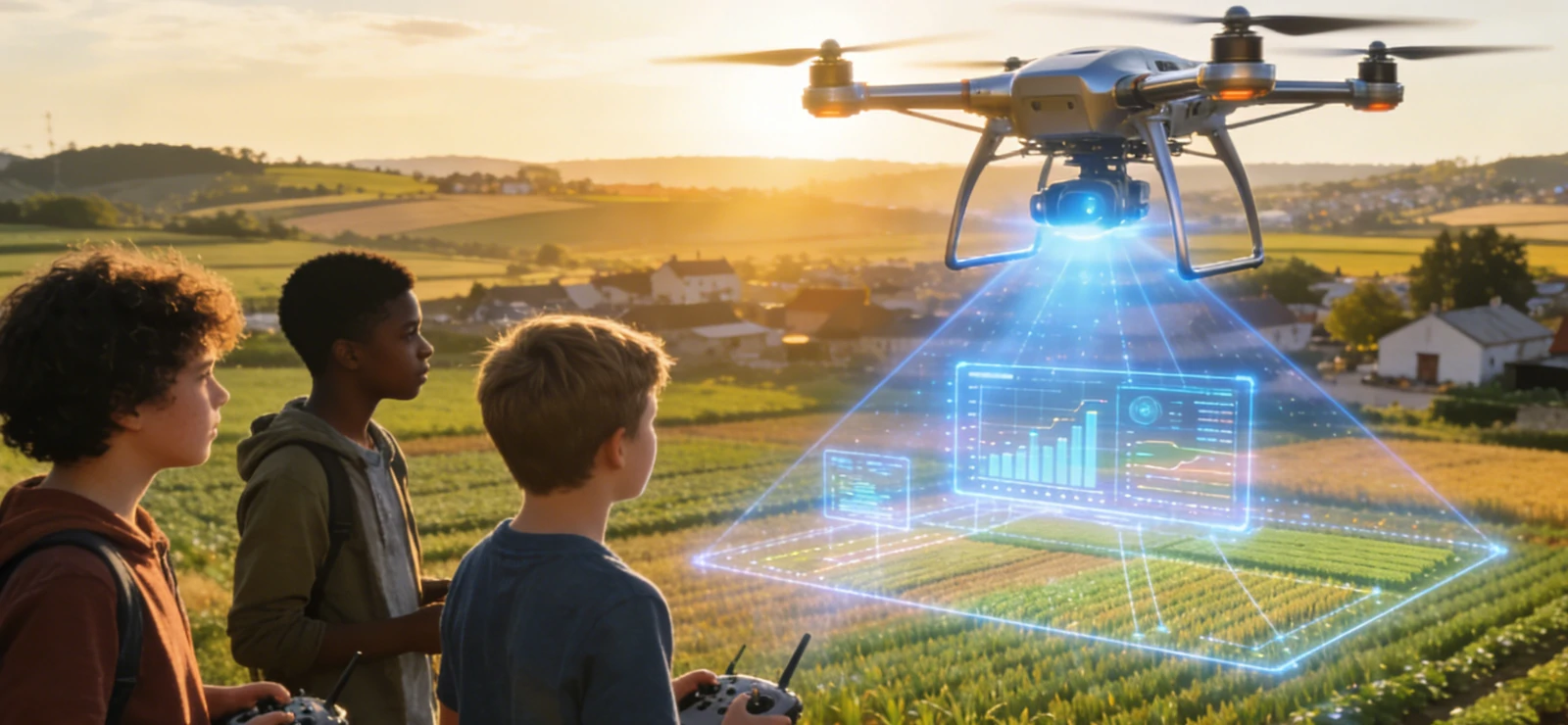
In agriculture, traditional farming relies heavily on manual labor or large farm machinery for pesticide spraying, fertilization, and crop monitoring. Manual spraying is not only time-consuming—covering just 20-30 mu per day—but also results in uneven pesticide distribution, wasting resources and harming the environment. While large machinery is faster than manual work, it is expensive to buy and maintain, and cannot access narrow fields or mountainous areas. In contrast, agricultural drones cover 800-1,000 mu per hour—30 times more efficient than manual labor—and their precision spraying reduces pesticide use by 30%. Equipped with multispectral cameras, they collect detailed crop data that manual observation or traditional ground sensors struggle to capture, helping farmers make better decisions and improve yields.
In infrastructure inspection, traditional methods often require workers to climb high-voltage power lines, bridges, or tall buildings—putting their lives at risk. For example, power line inspection once required teams to climb poles or use cranes, taking days to complete a single section and exposing workers to falls or electric shocks. Oil pipeline inspection, meanwhile, relied on ground teams driving long distances, often missing leaks in remote or hard-to-reach areas. Drones eliminate these risks by conducting aerial inspections, finishing tasks in hours that once took days. Power line inspection efficiency is improved by 15 times, and oil pipeline leak detection accuracy reaches 90%—all without endangering human lives. Compared to helicopters, another traditional aerial inspection tool, drones are far more cost-effective, with operational costs 70% lower and no need for professional pilots or landing pads.
In logistics and delivery, traditional methods depend on trucks, motorcycles, or couriers, which face challenges in crowded urban areas, remote regions, or emergency situations. Urban delivery often gets stuck in traffic, causing delays, while delivering to remote villages or mountainous areas is costly and time-consuming. Drones bypass these obstacles by flying directly to their destinations, especially in areas with poor road conditions. Companies like Amazon and Walmart are testing drone delivery, aiming to offer 30-minute urban delivery by 2028—cutting costs by 60% compared to traditional courier services. In emergencies, such as delivering medical supplies to disaster-stricken areas cut off by floods or earthquakes, drones can reach locations that traditional vehicles cannot, saving valuable time and lives.
In surveillance and search-and-rescue operations, traditional methods include human patrols, closed-circuit television (CCTV), and helicopters. Human patrols are limited by speed and coverage, while CCTV only monitors fixed areas. Helicopters are effective but expensive to operate and require clear weather. Drones, however, can cover large areas quickly—up to 10 square kilometers per hour—and access narrow or dangerous spaces, such as collapsed buildings or dense forests. Equipped with thermal imaging cameras, they can find missing people even at night or in low-visibility conditions, reducing search time by 80% compared to traditional methods.
Even in education and youth innovation, drones offer advantages over traditional teaching tools. Traditional STEM (Science, Technology, Engineering, and Mathematics) education often relies on textbooks and static models, making abstract concepts like aerodynamics or coding hard for students to understand. Drones provide hands-on experience: students can assemble, program, and fly drones, turning theoretical knowledge into practical skills. Compared to traditional science projects, drone-based learning is more engaging and interactive, fostering creativity and problem-solving skills that static teaching methods cannot match. Youth drone competitions, more accessible than traditional engineering competitions, also let more young people engage with cutting-edge technology, regardless of their background.
While traditional methods still have a role in some scenarios—such as small-scale farming or short-distance delivery—drones clearly outperform them in efficiency, safety, cost-effectiveness, and reach. Their ability to access hard-to-reach areas, reduce human risk, and provide accurate data makes them a better choice for many modern tasks. This comparison not only highlights the value of drone technology but also explains why it has become an indispensable tool today.
Beyond industrial and commercial uses, drones have become a powerful driver of education and youth innovation, bridging the gap between theoretical knowledge and practical application. In modern STEM education, drones are a core teaching tool, making abstract concepts in physics (aerodynamics), engineering (mechanical design), and computer science (coding and AI) tangible and engaging. Schools around the world have integrated drone training into their curricula: students learn to assemble drone components, program flight paths using coding languages like Python, and troubleshoot technical issues—building hands-on problem-solving skills and critical thinking.
Youth drone competitions and maker culture further fuel innovation among young people. Events like the International Drone Racing Championship and the DJI RoboMaster Youth Cup draw thousands of students each year, challenging them to design, modify, and fly drones for specific tasks—from navigating obstacle courses with precision to aerial photography and environmental data collection. These competitions not only spark a passion for technology but also build teamwork and creativity: young teams often collaborate to optimize drone performance, test new materials, and develop innovative solutions to technical challenges, laying the groundwork for future technological breakthroughs.
Additionally, drones empower young innovators to solve real-world problems, turning their ideas into actionable solutions. Teenagers have designed drones to monitor local wildlife habitats, deliver medical supplies to remote communities, and even assist local farmers with small-scale agricultural tasks. Educational initiatives, such as drone training workshops and student-led drone clubs, provide accessible opportunities for young people—regardless of their background—to work with cutting-edge technology, nurturing the next generation of engineers, pilots, and tech entrepreneurs. By integrating drones into education, we not only teach technical skills but also inspire a culture of innovation that will drive the future of the drone industry and beyond.
Despite their rapid development, drones face significant challenges. Technical bottlenecks include the energy density limit of lithium batteries (which is approaching theoretical limits) and the high cost of advanced sensors for autonomous flight. Regulatory and airspace management issues—such as rigid “one-size-fits-all” controls and complex approval processes—hinder the expansion of applications like urban delivery. Safety risks, including “black flying” (unauthorized flight in restricted airspace) and the spread of drone hacking technologies, also threaten public safety and regulatory order. Additionally, standardization gaps, such as inconsistent product identification codes, make tracking and supervision difficult.
Looking ahead, the future of drones lies in addressing these challenges while embracing emerging trends. The commercialization of solid-state batteries, expected by 2028, will increase energy density to 500Wh/kg, overcoming endurance limitations. AI and machine learning will further enhance autonomous capabilities, allowing drones to handle more complex tasks—from disaster response to urban air mobility (UAM). Integrating drones into air-space-ground integrated networks, such as China’s Hongyun Project, will expand their operational scope and reliability. Meanwhile, policy improvements—including differentiated airspace management and simplified approval processes—will unlock new application scenarios, from air tourism to urban commuting.
From their military origins to their current role as drivers of the low-altitude economy, drones have come a long way. As technology advances and regulatory frameworks mature, they will continue to transform industries, improve efficiency, and create new opportunities. The next decade will see a paradigm shift in drone technology—from incremental innovation to disruptive change—making drones an integral part of our daily lives and the global economy.