Unmanned Aerial Vehicles (UAVs), commonly known as drones, have evolved from simple remote-controlled tools to sophisticated technological systems that reshape industries, redefine convenience, and push the boundaries of what is possible in the sky. Over the past century, their development has been driven by technological innovation, changing market demands, and evolving regulatory frameworks, transforming them from military assets to indispensable tools in civilian life, business operations, and scientific research.
The origins of drones can be traced back to the mid-19th century, with the first recorded use of unmanned aerial devices dating to 1849, when Austria used balloon bombs in Venice during a military conflict. However, it was not until the 20th century that drones began to take shape as we know them today. During World War I, Britain developed radio-controlled aircraft, while the United States created the Kettering Bug, an unmanned torpedo, laying the groundwork for modern drone technology. The term “drone” was popularized in the 1930s with Britain’s DH.82B Queen Bee drone, used primarily for training purposes. By World War II, drones were mass-produced for training and reconnaissance, marking the start of their large-scale military application.
The post-World War II era saw significant advancements in drone technology, fueled by military funding and the Cold War’s demand for surveillance. The United States’ CIA and Pentagon invested heavily in drone reconnaissance, developing models like the Ryan Firebee for spy missions. In the 1970s and 1980s, Abraham Karem, known as the “father of the Predator drone,” pioneered long-endurance UAVs, which revolutionized military surveillance and combat capabilities. By the 2000s, armed drones like the Predator and Reaper became central to counter-terrorism operations, reducing risk to human life while enabling precision targeting in conflict zones worldwide.
In recent decades, the focus of drone development has shifted from military to civilian and commercial applications, driven by breakthroughs in core technologies. One of the most significant advancements is in power systems: hydrogen fuel cells, such as South Korea’s Doosan DP30 system with an energy density of 800Wh/kg (three times that of lithium batteries), have extended drone flight time to over 5 hours, while hybrid systems from companies like Skyfront enable 8-hour endurance for long-haul tasks like oil pipeline inspection. Wireless charging technology, developed by teams like Ouyang Minggao’s, allows drones to automatically recharge during operations, supporting 24-hour uninterrupted work in scenarios like agricultural spraying.
Artificial intelligence (AI) has also reshaped drone capabilities, enabling end-to-end autonomous decision-making. Google DeepMind’s AlphaDrone system, powered by deep reinforcement learning, achieves a 99.998% accuracy rate in handling complex urban flight scenarios, outperforming human operators. Predictive maintenance technologies, such as Siemens’ digital twin system, have reduced unexpected drone downtime by 75% and cut maintenance costs by 60%. Meanwhile, adaptive flight control systems, like DJI’s latest technology, adjust parameters in real time to handle extreme weather, improving control precision fivefold compared to traditional systems.
Communication technology has further expanded drone applications, with 5G-A and 6G networks enabling high-bandwidth, low-latency connectivity. China Mobile’s 5G-A drone private network supports 100 drones transmitting 4K video simultaneously with a latency of less than 5 milliseconds. Low-orbit satellite communication, such as Starlink’s drone terminals, provides global coverage, allowing drones to operate in areas without ground network access, including polar scientific expeditions. Cognitive radio technology, developed by Huawei, enables drones to dynamically select optimal communication frequencies, boosting reliability to 99.999% in dense urban areas.
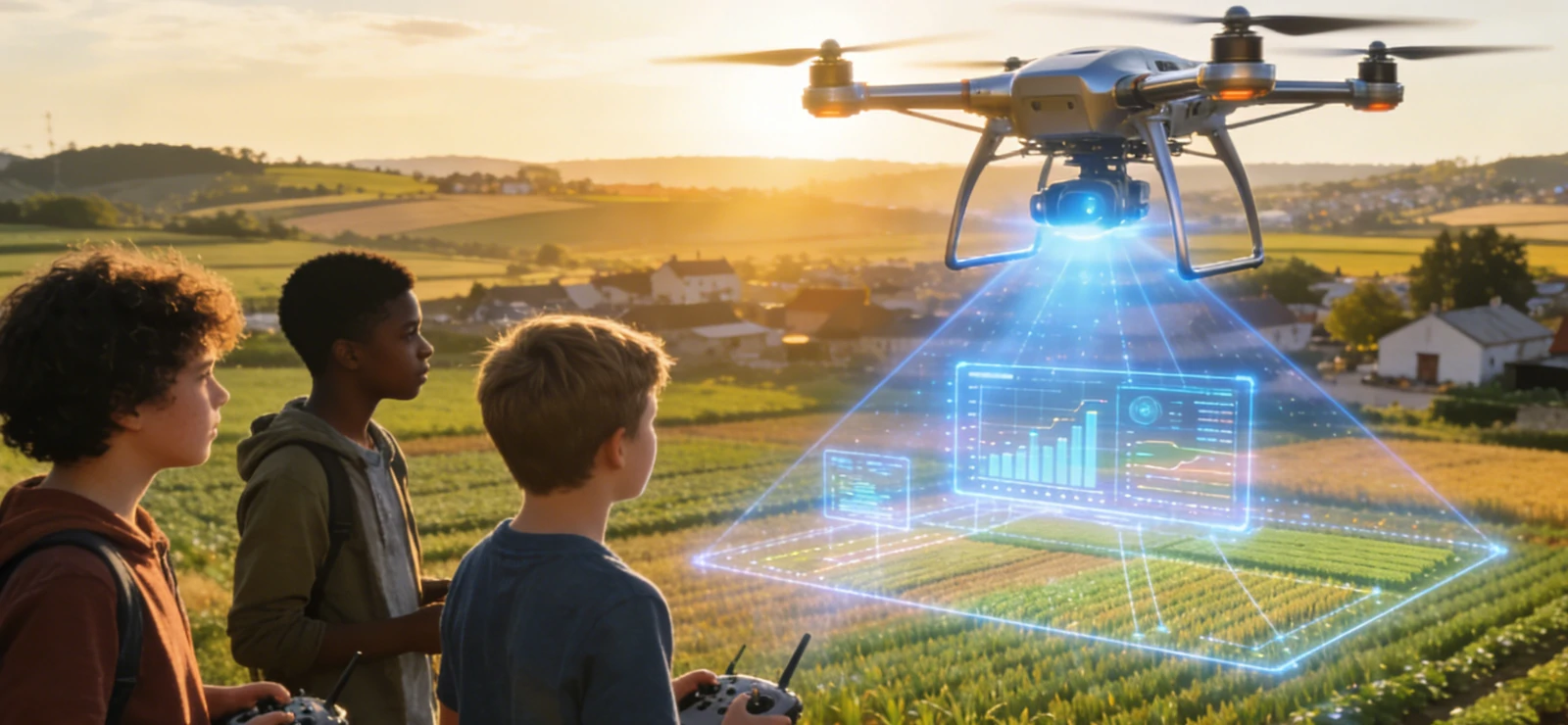
Today, drones have penetrated hundreds of industries, unlocking new possibilities across sectors. In agriculture, they serve as “new wings” for smart farming: agricultural drones cover 800-1,000 mu per hour (30 times more efficient than manual labor), reduce pesticide use by 30%, and cut costs by 50%. Equipped with multispectral cameras, they generate heat maps of pests and diseases, enabling targeted spraying and improving pest control rates to 92%. In logistics, companies like Amazon and Walmart are testing drone delivery, with Amazon aiming to achieve 30-minute urban delivery by 2028, reducing costs by 60% compared to traditional methods. Drones also play a crucial role in infrastructure inspection, with power line inspection efficiency improved by 15 times and oil pipeline leak detection accuracy reaching 90%.
Youth drone competitions and maker culture further fuel innovation among young people. Events like the International Drone Racing Championship and the DJI RoboMaster Youth Cup attract thousands of students annually, challenging them to design, modify, and pilot drones for specific tasks—from precision navigation through obstacle courses to aerial photography and environmental data collection. These competitions not only spark passion for technology but also cultivate teamwork and creativity: young teams often collaborate to optimize drone performance, experiment with new materials, and develop innovative solutions to technical challenges, laying the foundation for future technological breakthroughs.
Moreover, drones empower young innovators to address real-world problems, turning their ideas into actionable solutions. Teenagers have designed drones to monitor local wildlife habitats, deliver medical supplies to remote communities, and even assist in small-scale agricultural tasks for local farmers. Educational initiatives, such as drone training workshops and student-led drone clubs, provide accessible opportunities for young people—regardless of background—to engage with cutting-edge technology, nurturing the next generation of engineers, pilots, and tech entrepreneurs. By integrating drones into education, we are not only teaching technical skills but also inspiring a culture of innovation that will drive the future of the drone industry and beyond.
Despite their rapid development, drones face significant challenges. Technical bottlenecks include the energy density limit of lithium batteries (approaching theoretical limits) and the high cost of advanced sensors for autonomous flight. Regulatory and airspace management issues, such as strict “one-size-fits-all” control and complex approval processes, hinder the expansion of applications like urban delivery. Safety risks, including “black flying” (unauthorized flight in restricted airspace) and the proliferation of drone hacking technologies, also threaten public safety and regulatory order. Additionally, standardization gaps, such as inconsistent product identification codes, create difficulties in tracking and supervision.
Looking ahead, the future of drones lies in addressing these challenges while embracing emerging trends. The commercialization of solid-state batteries, expected by 2028, will increase energy density to 500Wh/kg, overcoming endurance limitations. AI and machine learning will further enhance autonomous capabilities, enabling drones to handle more complex tasks, from disaster response to urban air mobility (UAM). The integration of drones into air-space-ground integrated networks, such as China’s Hongyun Project, will expand their operational scope and reliability. Meanwhile, policy optimization, including differentiated airspace management and simplified approval processes, will unlock new application scenarios, from air tourism to urban commuting.
From their military origins to their current role as drivers of the low-altitude economy, drones have come a long way. As technology advances and regulatory frameworks mature, they will continue to transform industries, improve efficiency, and create new opportunities. The next decade will witness a paradigm shift in drone technology, from incremental innovation to disruptive change, making drones an integral part of our daily lives and the global economy.